A mid-size SaaS team we talked to put it bluntly: the answer they needed was written down somewhere, but nobody could find it across Slack, the wiki, and three different doc tools, so they rewrote it from scratch.
This problem is all-too-well-known to many companies we talk to every day.
When adopting tools for keeping their documentation updated and centralized, we discuss commonly - what framework are they using to manage their knowledge?
This guide covers the 6 types of KM framework, the 5 named models teams actually reference, the core components every framework shares, and how to pick and build one without chasing perfection.
Key takeaways
- A KM framework is a structured system to capture, organize, store, and share what your organization knows.
- There are 6 types of framework, grouped by approach: descriptive, prescriptive, hybrid, technology-based, culture-oriented, and process-oriented.
- 5 named models dominate the field: SECI, APQC, Microsoft, Dalkir's cycle, and the 90-10 rule.
- Every framework rests on the same core components: people, process, technology, content, and governance.
- Start small, focus on knowledge that would hurt to lose, and build the habit before the tooling.
What is a knowledge management framework?
A Knowledge Management (KM) framework is the structured system that fixes that. It captures, organizes, stores, and shares your organization's collective knowledge so the answer is findable the first time someone needs it.
Think of a KM framework as your company's "brain" management system: the structure that decides what gets written down, where it lives, and who keeps it current.
It is how you put knowledge management into practice, turning individual insight into shared knowledge the whole team can use so decisions get faster and problem-solving easier.
The purpose of these frameworks boils down to:
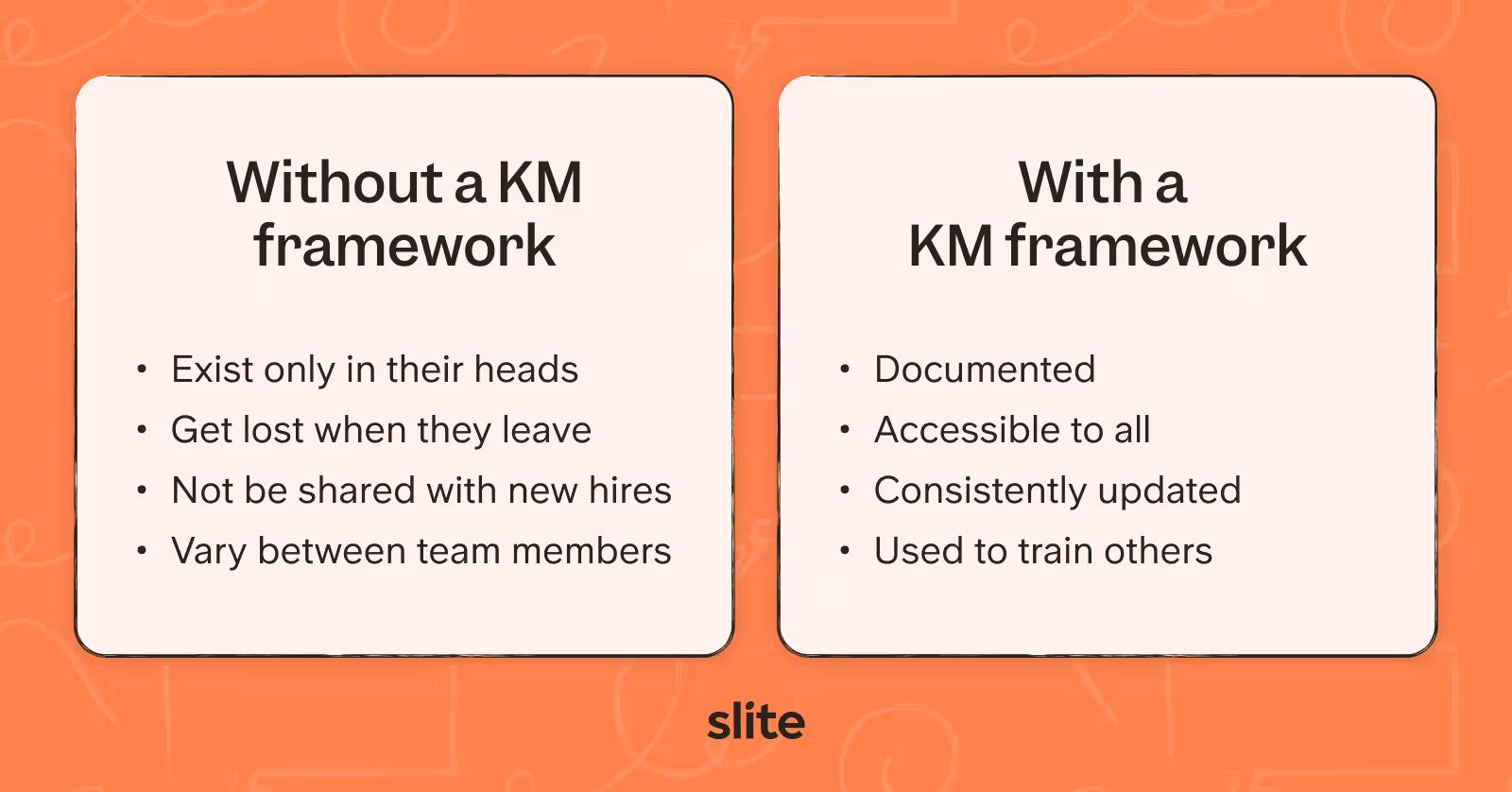
- Prevent knowledge loss when employees leave
- Keep tribal knowledge to a minimum
- Avoid reinventing the wheel
- Make information easily accessible, avoid information silos
- Turn individual knowledge into organizational assets
An effective knowledge management framework is essential to achieve these goals.
The core components of a knowledge management framework
Every knowledge management framework, whichever model it follows, rests on the same five components: the people who create and use knowledge, the processes that move it, the technology that stores it, the content itself, and the governance that keeps it trustworthy.
| Component | What it covers |
|---|---|
| People | Who creates, curates, and uses knowledge |
| Process | How knowledge flows through the organization (meetings, messages, handovers) |
| Technology | The tools used to store, search, and share knowledge |
| Content | The documents, answers, and assets themselves, kept accurate and relevant |
| Governance | Ownership, review cadence, and access rules that keep knowledge trustworthy |
Governance is the component most teams underinvest in, and it shows.
One logistics-tech team we spoke to found four different versions of the same process doc living in a traditional wiki tool, with roughly 80% of their docs duplicated, because no single person owned the review cadence.
When nobody feels responsible for keeping knowledge current, every other component slowly decays.
Benefits of implementing a knowledge management framework
Implementing a knowledge management framework brings several benefits:
| Benefit | What it looks like in practice |
|---|---|
| Better knowledge sharing | A structured approach encourages people to share insight, building a collaborative environment |
| More innovation | Accessible information lets employees build on existing knowledge instead of starting over |
| Faster decisions | A comprehensive knowledge base supports informed decisions and efficient problem-solving |
| Higher productivity | Less time spent searching means more time on core work |
| Better customer support | Customer-facing teams have the information they need to help quickly |
| Less knowledge loss | Documented knowledge survives when employees leave |
| Stronger compliance | Critical information is documented and accessible for audits and risk management |
| Sharper competitiveness | Teams that manage knowledge well adapt faster to market change |
Real-world example: imagine your sales team. They have:
- Best practices for closing deals
- Customer insights
- Common problem solutions
- Market knowledge
Types of knowledge management frameworks
There are 6 types of Knowledge Management framework, grouped by their approach to managing organizational knowledge.
| Type | Focus | Example frameworks |
|---|---|---|
| Descriptive | How knowledge flows and transforms; understanding current processes | SECI Model |
| Prescriptive | Step-by-step methodology for implementing KM from scratch | APQC Framework |
| Hybrid / integrative | Combines descriptive and prescriptive for a holistic approach | APO Framework |
| Technology-based | Digital infrastructure, tools, and systems for KM | AI search, knowledge platforms |
| Culture-oriented | Leadership, culture, and human behavior as KM drivers | Inukshuk Framework |
| Process-oriented | Systematic knowledge creation, storage, and reuse as business process | Wiig KM Framework |
1. Descriptive frameworks
Descriptive frameworks focus on identifying and describing the nature of knowledge management activities. These frameworks, like the SECI Model, help organizations understand how knowledge flows and transforms within their structure.
They emphasize the different forms of knowledge (tacit and explicit) and how explicit knowledge, such as employee guides and standard operating procedures, is captured and organized.
These frameworks are particularly valuable for organizations trying to understand their current knowledge processes before implementing specific solutions.
Some examples of descriptive frameworks are:
- Engineering team documenting how senior developers solve complex bugs
- Sales team recording successful pitch strategies in video format
- Product managers creating decision trees for feature prioritization
- Weekly "knowledge share" sessions where experts demonstrate their techniques
2. Prescriptive frameworks
Prescriptive frameworks provide specific methodologies and guidelines for implementing knowledge management.
The APQC Framework is a prime example, offering step-by-step guidance for organizations to follow.
These frameworks typically include detailed processes, tools, and techniques for knowledge capture, storage, sharing, and application.
They are especially useful for organizations that need a structured approach to implementing knowledge management from scratch.
Some examples are:
- Structured onboarding programs with specific knowledge checkpoints
- Mandatory documentation processes for client projects
- Standardized templates for project handovers
- Regular knowledge audits and updates
3. Hybrid or integrative frameworks
Integrative frameworks combine multiple aspects of knowledge management, addressing both the theoretical and practical aspects.
The APO Framework falls into this category, incorporating elements of both descriptive and prescriptive approaches.
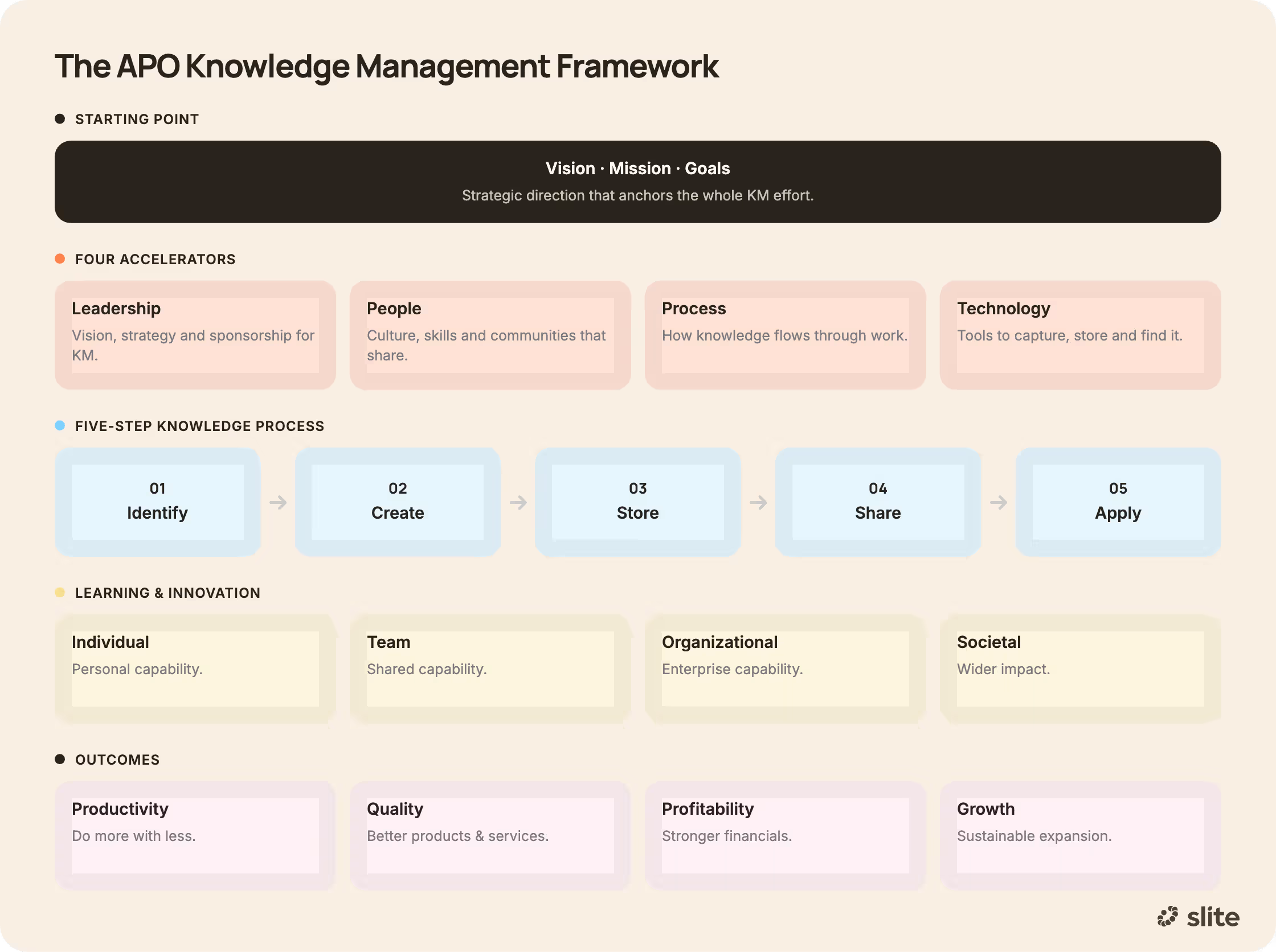
These frameworks tend to be more comprehensive and flexible, making them suitable for organizations that need a holistic approach to knowledge management.
Some examples:
- Cross-functional wikis combining technical and business knowledge
- Integration of CRM data with internal knowledge bases
- Combined approach of formal training and informal mentoring
- Department-specific knowledge bases linked to company-wide resources
4. Technology-based frameworks
Technology-based frameworks focus on the technological infrastructure and tools needed for effective knowledge management, including the implementation of a knowledge management platform.
These frameworks emphasize digital solutions, databases, collaboration tools, and information systems.
They are particularly relevant in environments where remote work is the norm.
Some examples:
- AI-powered knowledge search systems
- Cloud-based document management systems
- Collaborative platforms like Microsoft Teams or Slack with integrated knowledge bases
- Automated knowledge capture from email communications
Real Example:
Slite is a remote-first company that runs on:
- Linear for project work
- Slack for discussion.
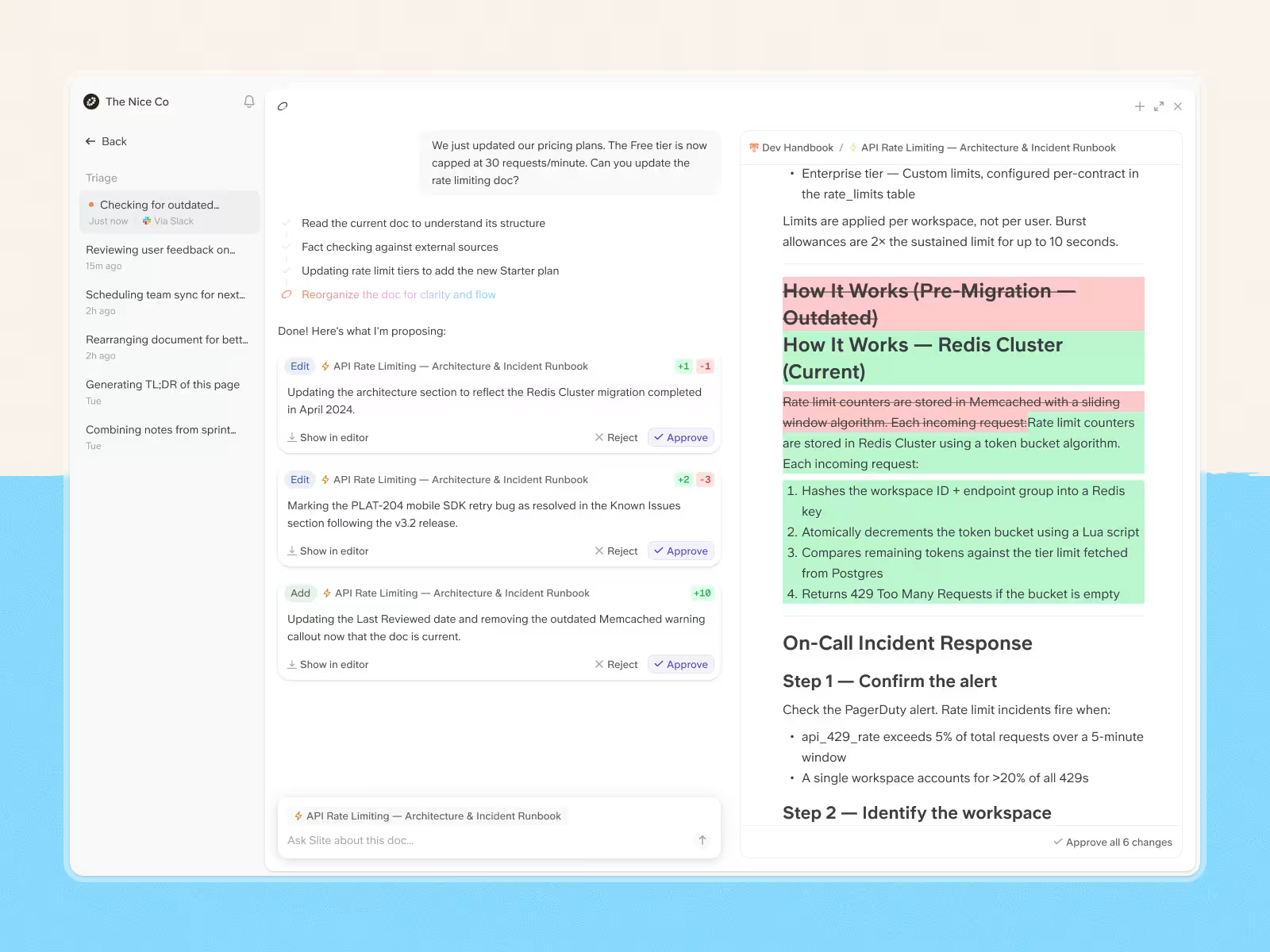
As teams grow and add tools, knowledge quietly drifts out of date and gets harder to find, even with a well-organized knowledge base. A self-maintaining knowledge base is what closes that gap.
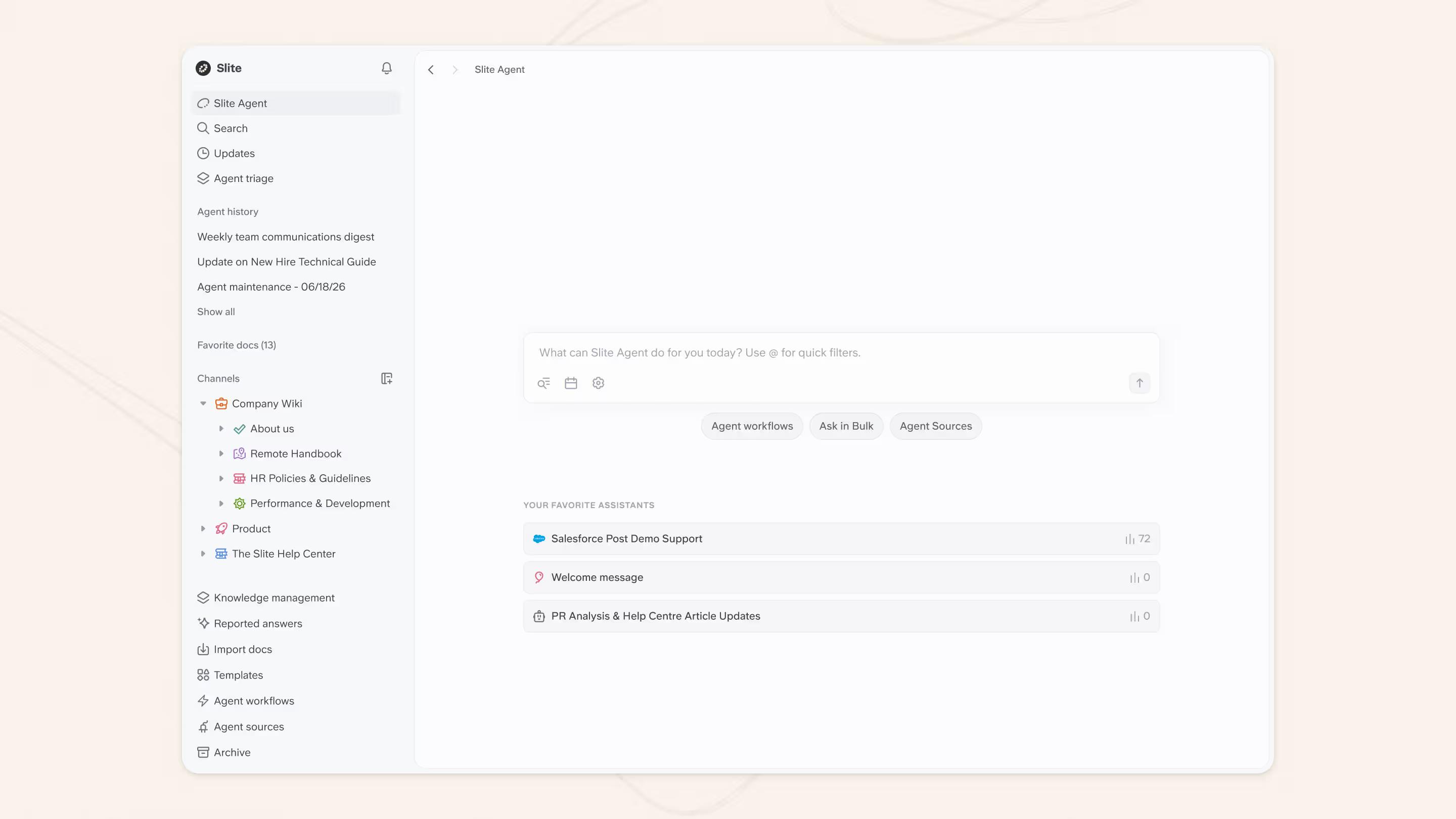
Slite Agent answers natural-language questions across your tools and keeps the underlying knowledge current.
Ask something like "What decisions were made about the API redesign?" and it pulls answers from Linear tickets, Slack conversations, and documentation, each with source citations.
It also detects when a doc has drifted from reality, drafts the fix, and routes it to your team for approval. That review-and-approve loop is what makes Slite a self-maintaining knowledge base rather than another search box.
This keeps the framework in active use instead of letting it decay into a digital filing cabinet.
In Slite's own enterprise search survey, teams reported losing an average of 4 hours per person per week just hunting for answers scattered across tools.
Slite connects 20+ tools and is reachable from Slack, a Chrome extension, and the web app, and via MCP, so AI agents like Claude can read and propose changes.
That makes your existing knowledge management investments more valuable without changing how teams work.
→ Ready to make your knowledge framework searchable? Book a demo to see how Slite Agent enhances knowledge accessibility.
5. Culture-oriented frameworks
Culture-Oriented Frameworks, like the Inukshuk Framework, prioritize the human and cultural aspects of knowledge management.
These frameworks emphasize leadership, organizational culture, and human behavior as key drivers of successful knowledge management.
They are particularly valuable for organizations undergoing cultural transformation or those looking to build a knowledge-sharing culture.
Some examples:
- "Ask Me Anything" sessions with leadership
- Recognition programs for knowledge sharing
- Communities of practice across departments
- Peer learning circles and mentorship programs
6. Process-oriented frameworks
Process-oriented frameworks focus on the systematic processes of knowledge creation, storage, sharing, and application, which are integral components of a well-implemented knowledge management process.
The Wiig KM Framework exemplifies this approach, emphasizing the business processes and value creation aspects of knowledge management.
These frameworks are particularly useful for organizations with strong process orientations or those looking to integrate knowledge management into their existing business processes.
Some examples:
- Standard operating procedures in digital format
- Process maps with embedded best practices
- Workflow documentation with decision points
- Quality control checklists with explanatory notes
The most recognised knowledge management frameworks
Five classic models come up again and again, plus two industry frameworks worth knowing. At a glance:
| Framework | Origin | Core idea | Best fit |
|---|---|---|---|
| SECI Model | Nonaka & Takeuchi (Japan) | Knowledge converts between tacit and explicit through four moves | Teams turning expert know-how into shared docs |
| APQC | American Productivity & Quality Center | Assess, design, implement, measure | Large orgs wanting measurable, scalable KM |
| Microsoft | Microsoft | People, process, technology embedded in everyday tools | Microsoft 365 / Teams-centric organizations |
| Dalkir's cycle | Kimiz Dalkir | Capture, share, update as a continuous loop | Fast-changing fields needing current knowledge |
| 90-10 Rule | KM practitioner heuristic | 90% people and culture, 10% tools | Teams over-investing in software before culture |
| TCS Framework | Tata Consultancy Services | Four dimensions: knowhow, people & culture, sharing & reuse, content & strategy | Large service orgs reusing knowledge across engagements |
| KCS | Consortium for Service Innovation | Capture knowledge while solving the problem | Support and IT service teams |
Let's look at each framework, in detail, one-by-one.
SECI model
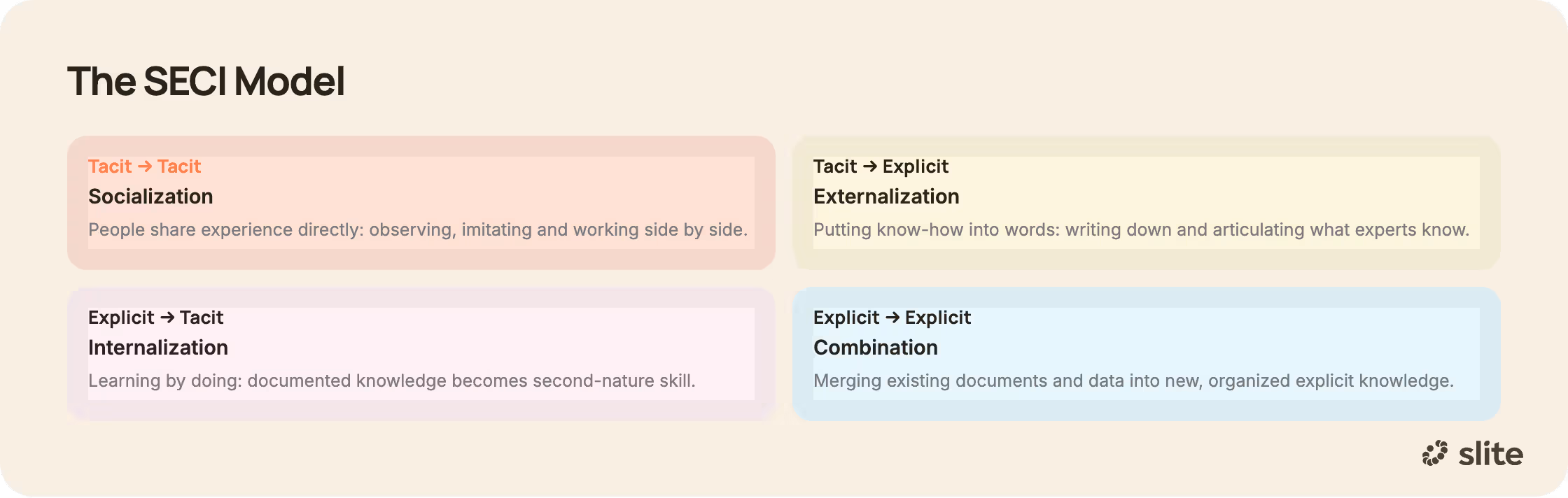
SECI Model breaks knowledge sharing into four natural movements: people sharing experiences (Socialization), writing down what they know (Externalization), combining different documents and data (Combination), and learning by doing (Internalization).
Example: Four friends sitting at a coffee shop, each teaching others what they know best. That's essentially what the SECI Model does at an organizational scale.
Japanese organizations like Toyota mastered this decades ago, and Silicon Valley caught on pretty quickly. The beauty lies in its simplicity. It mirrors how humans naturally learn and share knowledge.
APQC framework
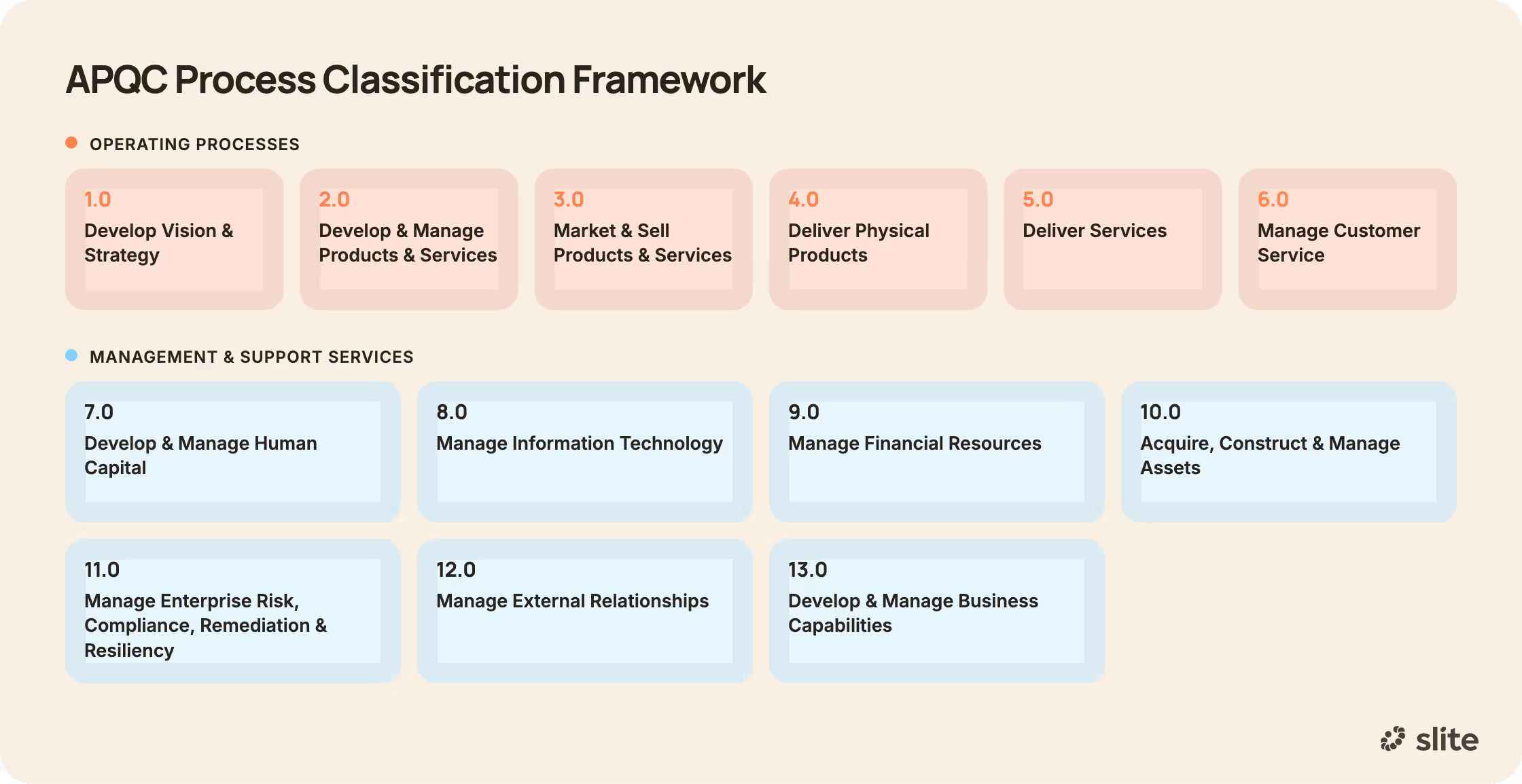
The APQC Framework comes from the American Productivity & Quality Center, founded in 1977, which studied successful knowledge management patterns across hundreds of organizations.
Its core strength lies in its systematic approach to manage knowledge through four key areas: strategy development, knowledge assessment, knowledge flow processes, and enabling factors.
The framework operates through a cycle of
- assessment (evaluating current knowledge state)
- design (creating strategies and structures)
- implementation (rolling out initiatives and training)
- measurement (tracking impact and adjusting approaches).
What sets it apart is its focus on measurable outcomes and its ability to scale across different enterprise knowledge management sizes, while focusing on both process efficiency and practical application.
Modern organizations adapt APQC to fit digital transformation needs and remote work scenarios. While implementation requires significant initial effort and consistent leadership support, the framework's structured approach to identifying, capturing, sharing, and measuring knowledge makes it particularly valuable for large organizations.
Microsoft's knowledge management framework
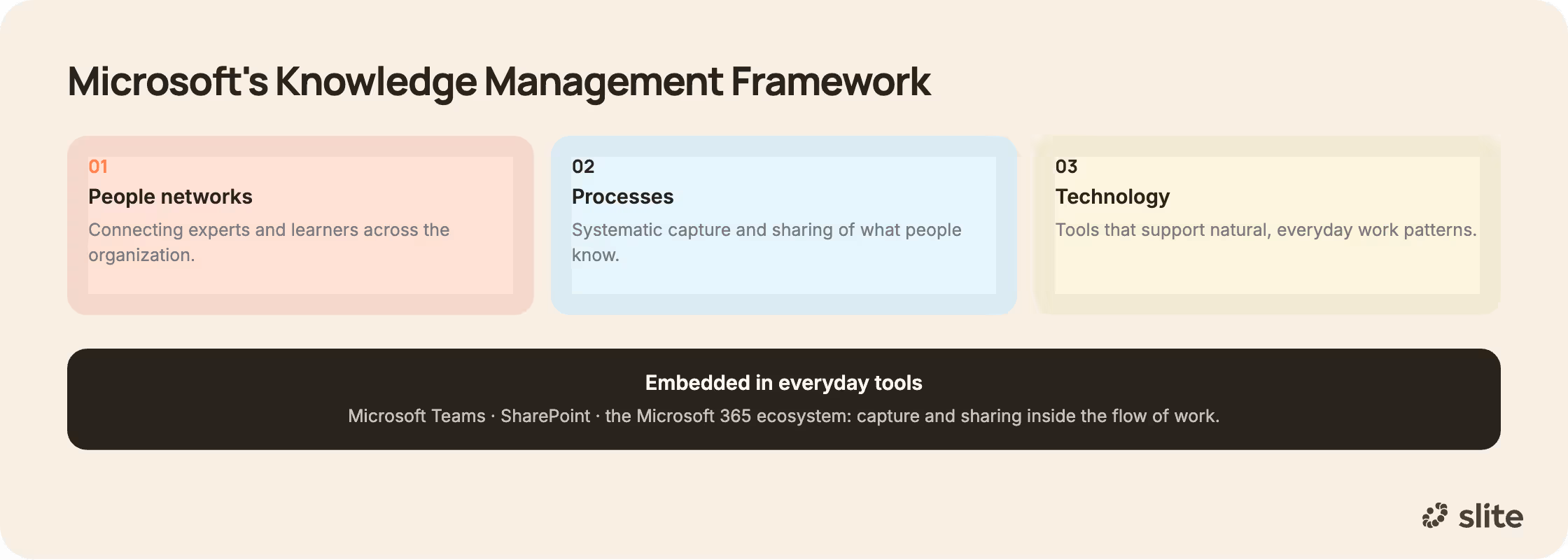
Microsoft's Knowledge Management Framework centers on three core elements:
- People networks (connecting experts and learners)
- Processes (systematic knowledge capture and sharing)
- Technology (tools that support natural work patterns).
The framework's popularity stems from its practical approach of embedding knowledge management into familiar tools like Teams, SharePoint, and the broader Microsoft 365 ecosystem. Rather than creating separate knowledge management systems, it treats everyday work activities - from email conversations to document collaboration - as opportunities for knowledge capture and sharing.
Implementation typically involves mapping organizational knowledge needs, setting up appropriate Microsoft tools, and establishing governance structures. Organizations like Accenture and KPMG have adapted this framework, appreciating its flexibility in scaling from small teams to enterprise-wide deployments.
The framework's success often depends on balancing automated knowledge capture with deliberate curation, while maintaining focus on business outcomes rather than tool adoption metrics.
Dalkir's knowledge management cycle
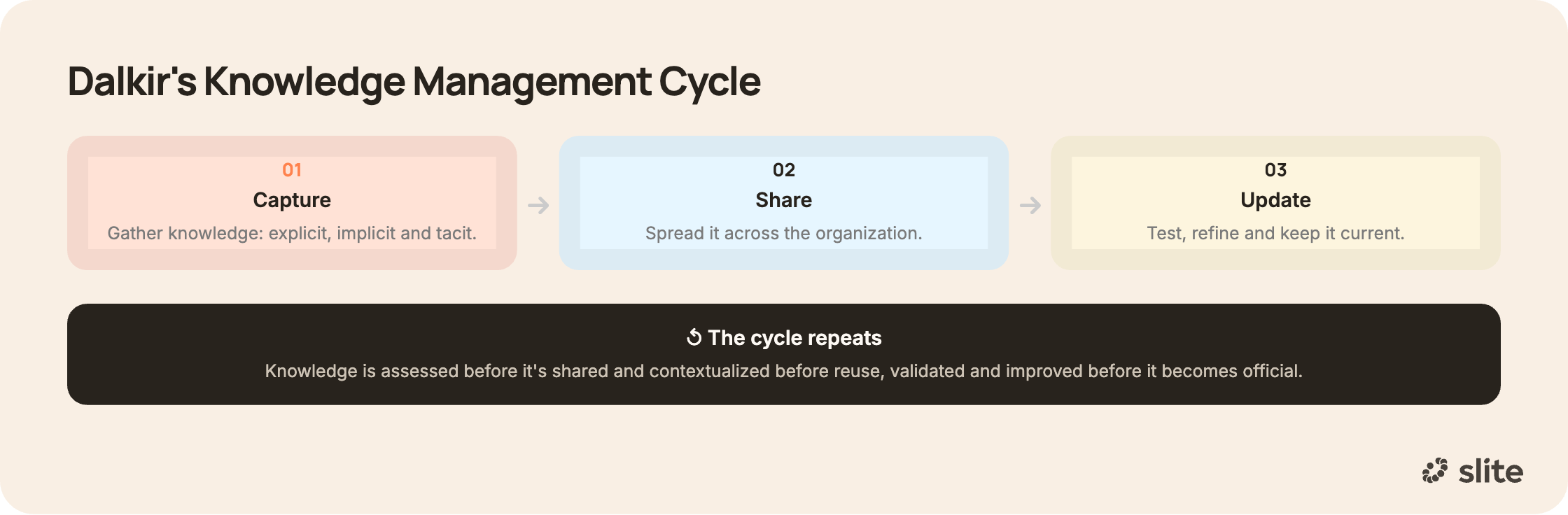
Kimiz Dalkir looked at how knowledge moves in organizations and made it simpler to understand. The model works like a loop with three main steps:
- Capture (getting knowledge)
- Share (spreading it around)
- Update (keeping it fresh)
Think of it like maintaining a shared cookbook - you collect recipes, share them with others, and update them as you find better ways to cook.
What makes Dalkir's model work well is how it handles the testing and fixing of knowledge, including explicit, implicit, and tacit knowledge. Before any information becomes "official," people test it, use it, and improve it.
Companies like Ernst & Young and Deloitte use this approach because it keeps their knowledge base current and useful. The model is especially good for organizations that need to stay up-to-date in fast-changing fields.
The 90-10 rule framework
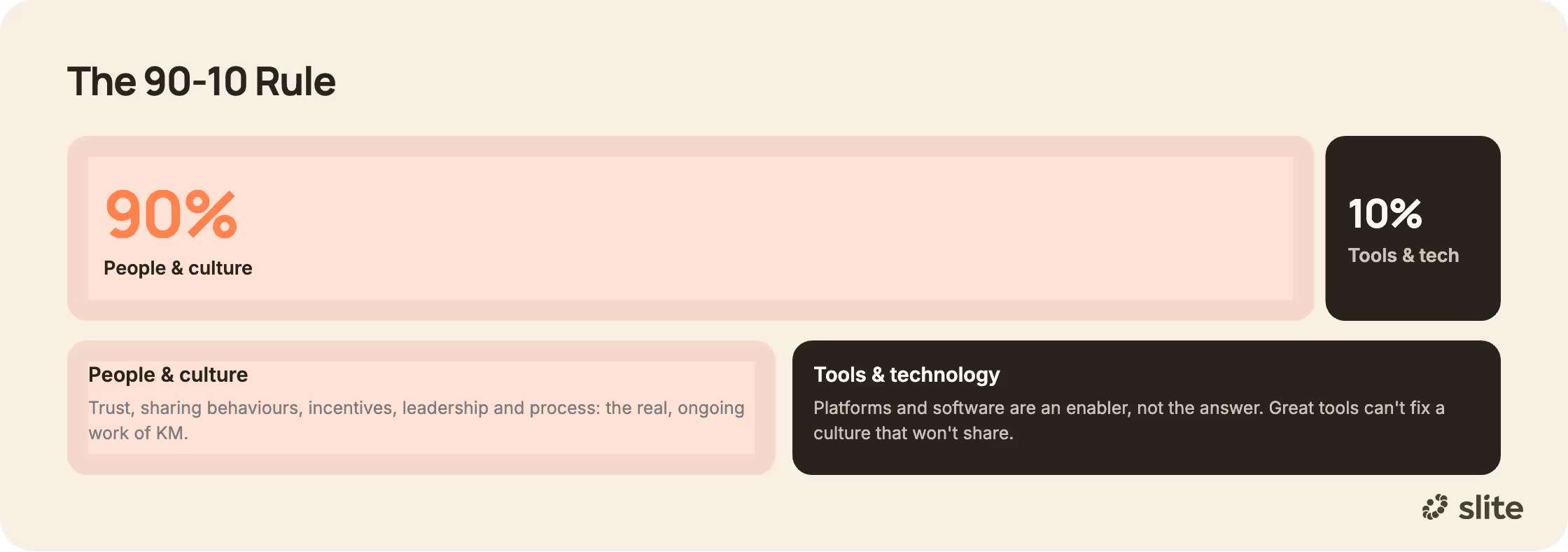
The 90-10 rule is refreshingly straightforward: 90% of knowledge management success comes from people and culture, while only 10% comes from tools and technology. It's like saying a great restaurant depends 90% on its chefs and food culture, and only 10% on having fancy kitchen equipment.
This framework helps organizations avoid the common trap of thinking new software will solve their knowledge sharing problems.
Culture-first companies, the kind that invest heavily in making knowledge-sharing natural before reaching for tools, embody this thinking. The real work lies in building trust, encouraging sharing, and making knowledge flow part of everyday work life.
TCS knowledge management framework
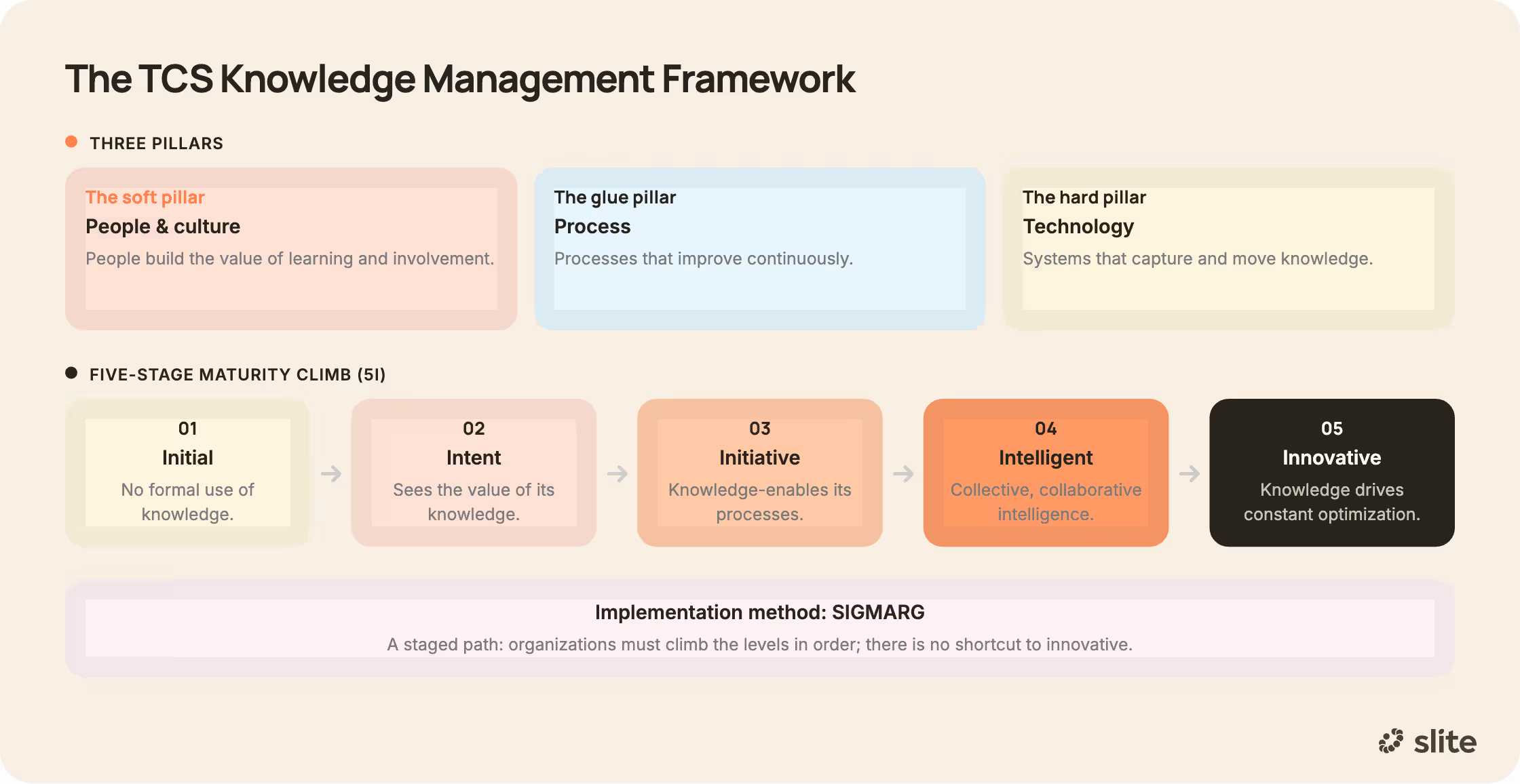
The TCS Framework, from Tata Consultancy Services, organizes knowledge management around four dimensions: Knowhow, People & Culture, Knowledge Sharing & Reuse, and Content & Strategy. It treats knowledge as an asset to be reused rather than recreated, which suits large service organizations running many similar engagements at once.
KCS (Knowledge-Centered Service)
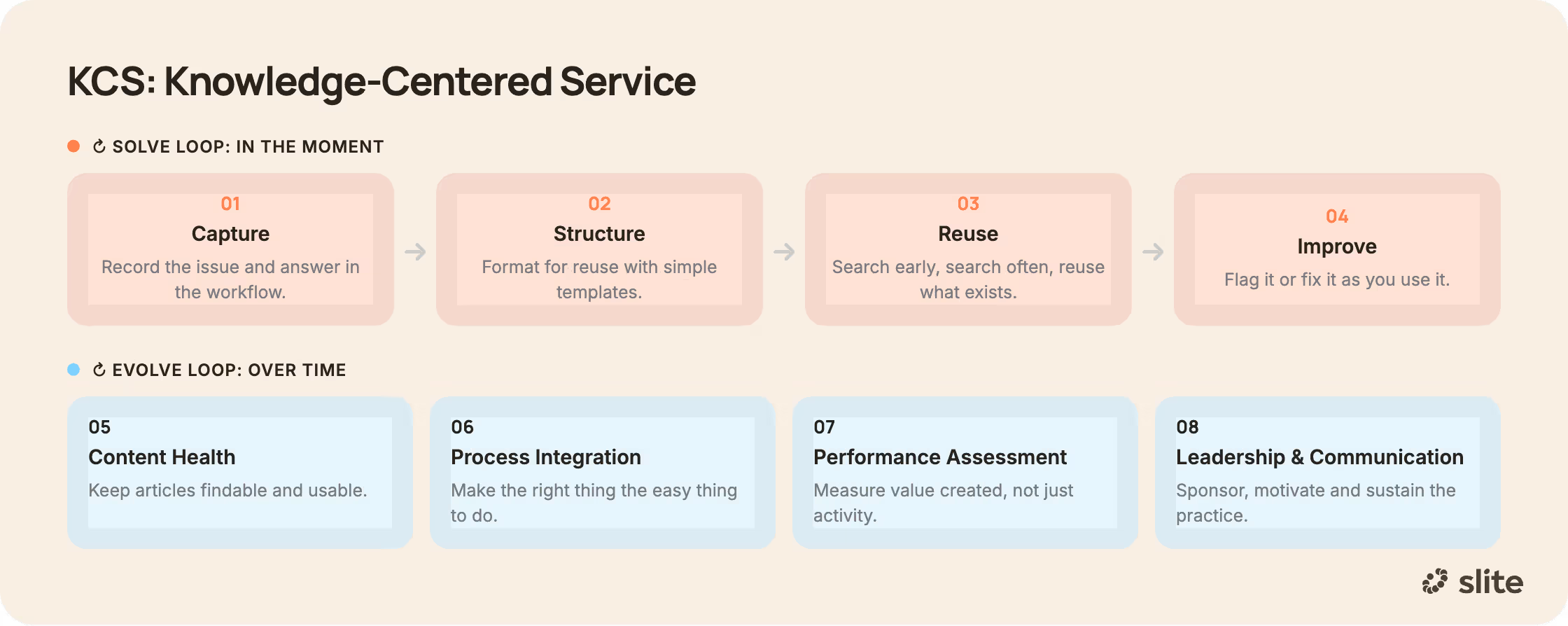
KCS, maintained by the Consortium for Service Innovation, builds knowledge capture into the act of solving a problem rather than treating documentation as a separate task. Support and service teams use it so that every resolved ticket leaves a reusable article behind, which is why it is popular in customer support and IT service organizations.
3 best practices for implementing a knowledge management framework
Working with thousands of companies closely on improving their knowledge management frameworks and practices, we now offer these three tips for knowledge base maintenance.
Keep it simple
Start with one area or department before expanding. The most successful programs begin with clear, focused goals tied to actual business needs, not vague aims to "improve knowledge sharing."
Build knowledge sharing into existing workflows rather than creating new ones. When BP linked engineer knowledge-sharing to their regular safety meetings, it worked better than separate knowledge sessions.
Make knowledge sharing easy to contribute
Cisco found that quick voice notes and short videos got better participation than asking people to write detailed documents. The key is removing barriers to sharing while maintaining quality.
Create clear ownership
Successful programs have dedicated people responsible for keeping knowledge fresh and relevant. IBM assigns "knowledge champions" in each department who spend part of their time managing their team's knowledge.
How to build a knowledge management framework (step by step)
The best-practice ideas above land best as a sequence. Build your framework one step at a time, keyed to the five core components:
- People: start where the pain is. Pick one team or department where knowledge loss already hurts, and name the knowledge champions who will own it. Begin with clear, focused goals tied to a real business need, not a vague aim to "improve knowledge sharing." As Donald Sipe at JobTarget put it when his team switched tools, the goal was to make the right answer the easiest one to find.
- Process: build sharing into existing workflows. Attach knowledge capture to work people already do, the way BP linked engineer knowledge-sharing to its regular safety meetings instead of running separate sessions.
- Content: lower the bar to contribute. Cisco found quick voice notes and short videos drew better participation than asking people to write detailed documents. Remove barriers while keeping quality high.
- Technology: add tools once the habit exists. Choose tools that fit how the team already works, not the other way around, and only after the sharing habit has started to form.
- Strategy and governance: assign ownership and measure. Give someone clear responsibility for keeping knowledge fresh, the way IBM assigns "knowledge champions" who spend part of their time curating their team's knowledge, then track whether it is actually being used.
4 common mistakes
There are 4 mistakes that we commonly happen when our clients try to implement a knowledge management system or framework and get stuck:
| Mistake | What it looks like | The fix |
|---|---|---|
| The "Build It and They Will Come" trap | Launching fancy knowledge platforms before creating a sharing culture | Build the culture first; many organizations learn this the expensive way |
| Treating all knowledge as equal | Trying to capture everything instead of what's critical | Prioritize, the way Shell did to make its program manageable and useful |
| Over-relying on a knowledge management system | Buying complex systems when simple tools would work | Match the tool to the need; Microsoft's research shows basic chat and docs often beat specialized tools |
| Forgetting to maintain and update | Letting knowledge bases go unreviewed | Review on a cadence that fits your industry's rate of change |
On that last point, few teams keep up.
Our own analysis of real workspaces found that the large majority of active content, around 94%, went untouched in a given month, and a complementary look at the data showed only about 1 in 20 docs gets updated.
Maintenance is where most frameworks quietly fail.
Measuring effectiveness and continuous improvement
Measuring the effectiveness of a knowledge management framework is crucial to ensure it is achieving its intended objectives and to identify areas for improvement.
Two lenses help: the metrics you track day to day, and the methods you use to evaluate success over time.
Analytics and metrics for knowledge management
| Metric type | What it measures |
|---|---|
| Usage | Users, page views, and searches, to gauge overall engagement |
| Engagement | Comments, ratings, and feedback, to show how actively people participate |
| Content | Quality, relevance, and accuracy, to keep the knowledge base valuable |
| Process | Efficiency of KM processes, to find bottlenecks |
| Outcome | Impact on revenue, customer satisfaction, and innovation, to show tangible benefit |
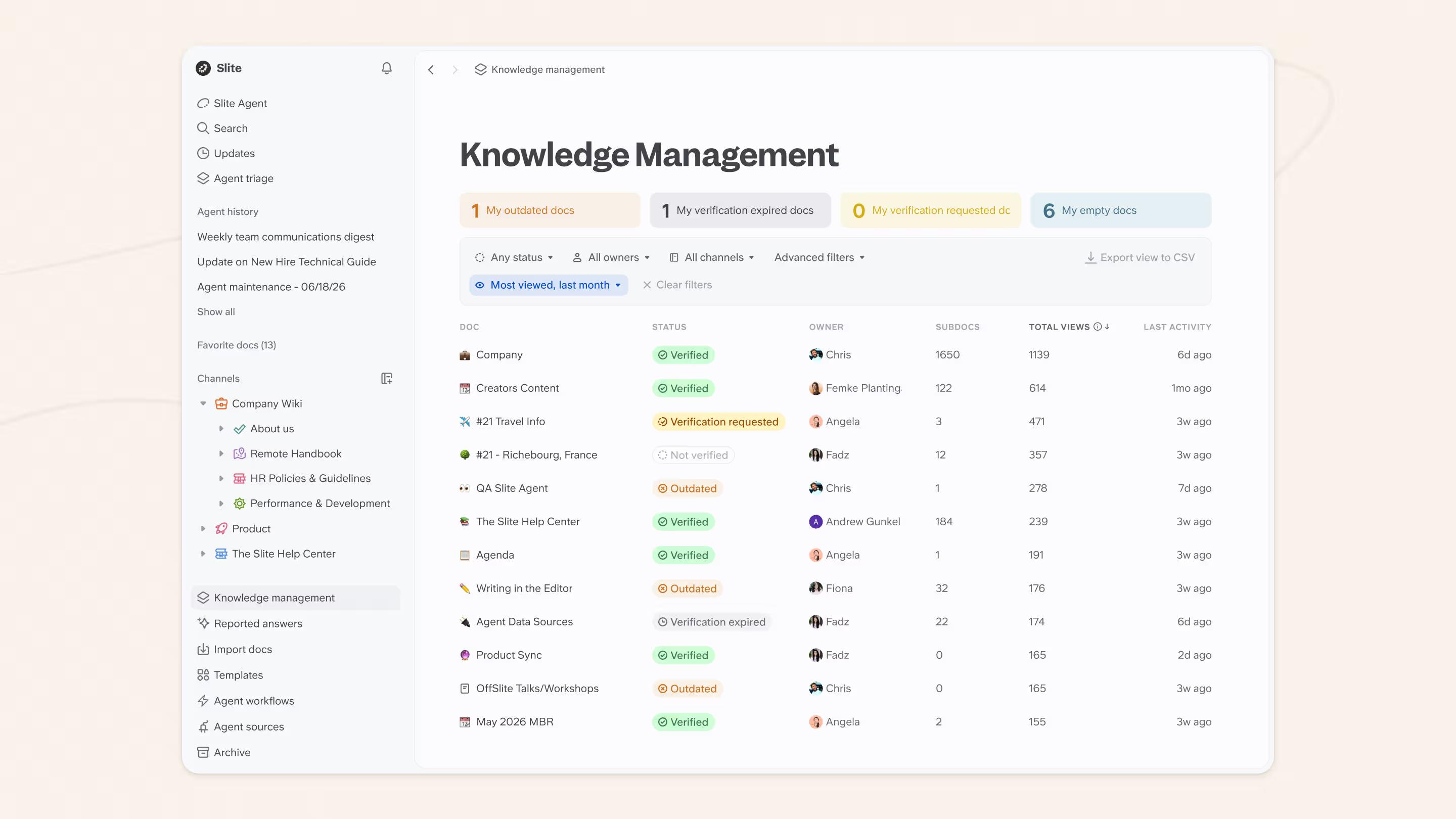
When using dedicated knowledge base solutions such as Slite, you can take advantage of product features such as the Knowledge management panel to gain a quick and regular overview:
Evaluating knowledge management success
| Method | What it tells you |
|---|---|
| Surveys and feedback | How users and stakeholders perceive and experience the system |
| Case studies | Which initiatives worked, and their impact on the organization |
| Benchmarking | How your practices compare with industry best practices |
| ROI analysis | The financial return and value of your KM initiatives |
By regularly evaluating and improving the knowledge management framework, organizations keep it aligned with their changing needs and goals.
This continuous improvement keeps the system responsive and supports the organization's long-term success.
Wrapping up
Starting a knowledge management program doesn't have to be overwhelming. Begin where you'll see quick wins, perhaps with your most experienced team members or in departments where knowledge loss is a pressing concern.
Ask yourself:
What knowledge, if lost tomorrow, would hurt us the most?
Your first steps might be as simple as:
- Setting up regular 15-minute sessions where team members share key learnings
- Creating a simple template for capturing important decisions and their context
- Identifying your "go-to people" and having them record their most frequently asked questions
Remember that perfect is the enemy of good.
Start small, focus on valuable knowledge rather than trying to capture everything, and make sharing as easy as possible. The goal is to help your team work better and keep valuable insights from walking out the door.
Most importantly, think of knowledge management as a habit to build, not a project to finish. Like keeping a garden, it needs regular attention but doesn't have to be time-consuming if you do a little bit often.
Need more help? We build Slite, the self-maintaining knowledge base, a company brain that notices when your docs drift from reality and proposes the fix for your team to approve. If you're looking to implement knowledge management in your organization, talk to us.
FAQ
What are the four dimensions of the TCS knowledge management framework?
The TCS Framework, from Tata Consultancy Services, is built on four dimensions: Knowhow, People & Culture, Knowledge Sharing & Reuse, and Content & Strategy. Together they treat organizational knowledge as a reusable asset rather than something each team recreates.
What is a knowledge management governance framework?
A knowledge management governance framework is the set of rules that keeps a knowledge base trustworthy: who owns each area of knowledge, how often it gets reviewed, and who can edit or access it. Without it, the other components drift, which is how teams end up with four versions of the same doc and no single source of truth.
How do you measure knowledge management success?
Measure it on two levels. Track day-to-day metrics like usage, engagement, content quality, and process efficiency, then evaluate longer-term impact through surveys, case studies, benchmarking, and ROI analysis. The clearest signal is whether the knowledge is actually being found and used when people need it.
What's the difference between a knowledge management framework and a model?
A framework is the broad approach your organization takes to capturing and sharing knowledge, covering people, process, technology, content, and governance. A model, like SECI or Dalkir's cycle, is a specific, named pattern you can adopt inside that framework. Most teams choose a framework type first, then borrow from one or more models to fill in the how.